Oregon State Facts & Information
State Information
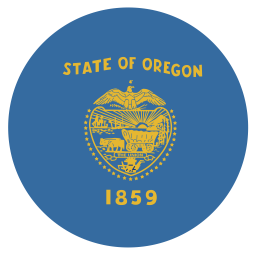
- State Flag:
Quick Facts (2024)
- Population: 4.27 million (27th largest state)
- Capital: Salem
- Governor: Tina Kotek (D)
- GDP: $331 billion
- GDP per capita: $62,061
- Median Household Income: $80,426
- Statehood: February 14, 1859 (33rd state)
- Nickname: The Beaver State
Frequently Asked Questions About Oregon
Oregon's gross state product in 2024 was $331 billion, ranking 25th largest in the nation. The forested mountains of western and northeastern Oregon supply the traditional core of the state's economy, producing a major portion of the country's softwood lumber, plywood, hardboard, pulp, and paper. High-tech industries in the Silicon Forest have been a major job source since the 1970s, with Intel as the state's largest for-profit private employer. Oregon is also one of four major world hazelnut growing regions, producing 95% of domestic hazelnuts in the United States. The information industry grew the most, with 2024 GDP 2.6 times the 2014 GDP.
Crater Lake was formed when Mount Mazama collapsed around 7,700 years ago. It reaches a depth of 1,949 feet, making it the deepest lake in the United States. The lake's astonishing clarity and deep blue color mesmerize visitors from around the world. It is the centerpiece of Crater Lake National Park, one of Oregon's premier natural attractions, offering breathtaking views and outdoor activities throughout the year.
Oregon's state flag is unique because it pictures a beaver on its reverse side. It is the only state flag in the United States to carry two separate designs - one on each side. This makes it distinctive among all U.S. state flags. The beaver is fitting given Oregon's nickname as "The Beaver State," and the state is also the only one with an official state nut - the hazelnut (also known as a filbert).
Oregon's tourism is centered on natural features including Crater Lake National Park, Multnomah Falls, the Painted Hills, the Deschutes River, and the Oregon Caves. Mount Hood and Mount Bachelor draw visitors year-round for skiing and snow activities. Powell's Books in Portland spans a full city block and is the largest independent bookstore in the world, housing more than one million books. Portland also has the largest number of breweries of any city in the world. The state's coastline, forests, waterfalls, rivers, and beaches offer stunning natural beauty throughout.
Yes, while most people assume the Grand Canyon is the deepest canyon in the country, the honor actually belongs to Oregon. Found on the border between Oregon and Idaho, the Snake River cuts through Hells Canyon, the deepest canyon in North America. This natural wonder offers dramatic scenery and outdoor recreation opportunities, showcasing Oregon's diverse and spectacular landscape.
Oregon holds several fascinating world records. Mill Ends Park in Portland is the world's smallest park at just two square feet in area. Located in the Malheur National Forest, the Honey Mushroom (Armillaria ostoyae) weighs an estimated 7,500 tons and covers 4 square miles, making it the largest organism on earth. Oregon has more ghost towns than any other state. Additionally, Powell's Books in Portland is the largest independent bookstore in the world, and Portland has the largest number of breweries of any city worldwide.
Oregon's estimated population at the end of 2024 was 4.27 million, a modest increase of 18,718 (0.44%) from 2023. The state's total fertility rate is assumed to remain close to 1.4 per woman, well below the replacement level fertility of 2.1 children per woman. This phenomenon of "natural decrease" means Oregon has become dependent on net in-migration for population growth. In the absence of migration, Oregon's population would be in decline. There was a net migration of around 17,000 new residents to the state. Multnomah County (Portland) remains largest at 780,000 residents but has declined 4.5% since 2020, while Deschutes County has grown 6.6%, with Crook County showing the fastest growth at 12.7%.
Nike was founded in Oregon by track-and-field coach Bill Bowerman at the University of Oregon and his former student Phil Knight in 1964. The company was originally called Blue Ribbon Sports and was renamed Nike in 1978. Today, Nike is one of the world's most recognizable brands and remains headquartered in Oregon, contributing significantly to the state's economy and reputation for innovation in the athletic and outdoor industries.
Last updated on November 29, 2025