New Hampshire - The Granite State
About New Hampshire
New Hampshire, known as "The Granite State," is a state in the New England region of the Northeastern United States. With a population of approximately 1.4 million, it is the 10th least populous state in the nation. The state capital is Concord, while Manchester is the largest city with over 115,000 residents.
New Hampshire became the 9th state to join the Union on June 21, 1788, and played a crucial role in American history as one of the original 13 colonies. The state was the first colony to establish its own constitutional government in 1776, and it cast the deciding vote to ratify the United States Constitution in 1788.
The state's motto, "Live Free or Die," reflects its role in the American Revolutionary War and the independent spirit of its residents. This motto, penned by Revolutionary War General John Stark, is one of the most recognized state mottos in America and has appeared on New Hampshire license plates since 1971.
Today, New Hampshire is known for holding the first-in-the-nation presidential primary, its lack of sales and income taxes, spectacular fall foliage, world-class skiing in the White Mountains, and its historic 18-mile seacoast along the Atlantic Ocean.
State Flag
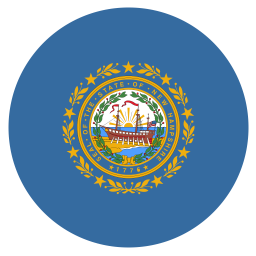
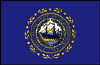
The New Hampshire state seal features the frigate Raleigh, built in Portsmouth for the Revolutionary War, with a rising sun in the background. The nine stars represent New Hampshire as the ninth state to ratify the Constitution.
Quick Facts
- Capital: Concord
- Largest City: Manchester (115,000+)
- Nickname: The Granite State
- Motto: Live Free or Die
- Statehood: June 21, 1788 (9th state)
- Time Zone: Eastern (UTC-5/-4)
- Borders: Canada (N), Maine (E), Massachusetts (S), Vermont (W)
- Coastline: 18 miles on Atlantic Ocean
- Median Age: 43.4 years
Geography & Climate
Geographic Regions
New Hampshire features diverse geographic regions:
- Great North Woods: Vast wilderness in the north
- White Mountains: Rugged peaks including Mount Washington (6,288 ft)
- Lakes Region: Home to Lake Winnipesaukee (72 square miles)
- Seacoast: 18 miles of Atlantic coastline
- Merrimack Valley: Southern corridor with major cities
- Monadnock Region: Southwestern hills and valleys
Borders & Natural Features
New Hampshire borders four states and Canada:
- North: Quebec, Canada
- East: Maine and Gulf of Maine
- South: Massachusetts
- West: Vermont (Connecticut River)
Notable Features:
- Shortest ocean coastline of any coastal state (18 miles)
- Mount Washington: Highest peak in Northeast (6,288 ft)
- White Mountain National Forest (800,000 acres)
- Isles of Shoals: 9 islands (4 in NH, 5 in Maine)
Major Cities & Counties
Largest Cities
Manchester Largest
📍 Hillsborough County
Population: 116,386
Northern New England's largest city, located on the Merrimack River. Major economic and cultural hub with diverse demographics.
- Median household income: $77,415
- Mayor-alderman government
Nashua 2nd Largest
📍 Hillsborough County
Population: 91,851
Ranked "Best Place to Live in America" by Money magazine in 1987 and 1998 - the only city to achieve this twice.
- Southern NH location
- Strong business community
Concord Capital
📍 Merrimack County
Population: 44,674
State capital and county seat. Center of state government and administration.
- Historic downtown
- Political hub
Derry
📍 Rockingham County
Population: 34,062
Dover
📍 Strafford County
Population: 33,909
Most populous Seacoast city
Rochester
📍 Strafford County
Population: 33,598
Salem
📍 Rockingham County
Population: 31,673
10 Counties
New Hampshire has 10 counties, 13 cities, and 221 towns. The four southern counties account for 72% of the state's population.
- Hillsborough County: Most populous (427,000), includes Manchester and Nashua
- Rockingham County: Second largest (323,000), coastal region
- Merrimack County: Includes state capital Concord
- Strafford County: Seacoast region
- Belknap County: Lakes Region
- Carroll County: Fastest growing (5.6%)
- Cheshire County: Southwestern region
- Grafton County: Includes Dartmouth area
- Sullivan County: Western border
- Coös County: Largest by area, northernmost, sparsely populated
Economy & Tax Advantages
🎉 No Sales Tax, No Income Tax (2025+)
As of January 1, 2025, New Hampshire is one of only two states (along with Alaska) with no income tax and no sales tax. The state's Interest and Dividends Tax has been fully phased out.
💰 Tax Structure
- Sales Tax: None (constitutionally protected)
- Income Tax on Wages: None
- Interest & Dividends Tax: Eliminated in 2025 (was 3% in 2024)
- Corporate Income Tax: 7.5%
- Property Tax: 1.89% average (4th highest in U.S.)
State Tax Competitiveness: Ranked 3rd nationally in 2026 State Tax Competitiveness Index
📊 Special Taxes & Fees
- Hotel Rooms: 8.5%
- Restaurant Meals: 8.5%
- Communications Services: 7%
- Electricity: $0.00055 per kilowatt hour
Note: Instituting a sales tax would require a constitutional amendment, which has been rejected by voters multiple times.
📈 Economic Performance
New Hampshire's tax-friendly policies have contributed to strong economic growth. The state experienced its lowest unemployment rate in history following tax reductions. The state ranks among the wealthiest and most-educated in the nation, tying with Massachusetts for the highest Human Development Index score.
Attractions & Tourism
White Mountains & Mount Washington
Mount Washington Extreme Weather
At 6,288 feet, Mount Washington is the highest peak in the Northeastern United States and famous for having the "world's worst weather."
Weather Records:
- Wind speed record: 231 mph (April 12, 1934) - world record for 62 years
- Coldest wind chill in U.S. history: -108.4°F (February 2023)
- Hurricane-force winds: Average 110 days per year
- Average snowfall: 280 inches per season
Access:
- Mount Washington Auto Road (historic toll road)
- Mount Washington Cog Railway (world's first mountain-climbing train)
- Hiking trails including Tuckerman Ravine
- Mount Washington Observatory (year-round weather station)
Fall Foliage
🍁 Autumn Spectacular
New Hampshire attracts nearly 4 million visitors during fall foliage season, generating approximately $1.8 billion in tourism revenue annually.
Peak Season:
- White Mountains: Mid-September to mid-October
- Earlier than most New England states
Scenic Routes:
- Kancamagus Highway (Route 112)
- Franconia Notch State Park
- Crawford Notch State Park
Activities:
- Leaf-peeping drives
- Hiking with fall colors
- Photography tours
Skiing & Winter Sports
⛷️ Major Ski Resorts
- Bretton Woods: State's largest ski area
- Loon Mountain: Lincoln area
- Wildcat: Pinkham Notch
- Cannon Mountain: Franconia
- Cranmore Mountain: North Conway
- Mount Sunapee: Newbury
- Gunstock: Gilford (Lakes Region)
- Attitash: Bartlett
❄️ Winter Activities
- Downhill skiing and snowboarding
- Cross-country skiing
- Snowmobiling
- Snowshoeing
- Ice fishing on frozen lakes
- Ice climbing
- Winter hiking
Season typically runs from mid-November through April.
Lakes Region
Lake Winnipesaukee 72 sq mi
New Hampshire's largest lake, covering 72 square miles with crystal-clear, spring-fed water.
Water Activities:
- Boating and sailing
- Kayaking and canoeing
- Stand-up paddleboarding
- Water skiing and wakeboarding
- Jet skiing
- Fishing (trout, salmon, bass)
- Swimming at 10 public beaches
Towns & Villages:
- Laconia
- Wolfeboro (oldest summer resort)
- Moultonborough
- Weirs Beach
- Meredith
Attractions:
- Mount Washington Cruises
- Castle in the Clouds
- Funspot (world's largest arcade)
- Scenic railroad tours
- Granite State Rail Bikes
Seacoast Region
⚓ Portsmouth - Historic Port City
NH's most walkable city with cobblestoned streets and brick sidewalks.
- Strawbery Banke Museum: 10-acre outdoor history museum, 32 buildings spanning 300 years
- Governor John Langdon House: Georgian mansion with gardens
- Warner House (1716): Oldest wall murals in U.S.
- John Paul Jones House: Revolutionary War hero residence
- Jackson House (1664): Oldest wood frame house in NH and Maine
🏖️ Hampton Beach & Coast
Classic New England beach town with year-round activities.
- 18 miles of Atlantic coastline (shortest of any coastal state)
- Free concerts at band shell
- Weekly summer fireworks
- Casino Ballroom entertainment venue
- Hampton Beach Seafood Festival (September)
- Sand Sculpting Competition (June)
- Wallis Sands State Beach
- Odiorne Point State Park
🏰 Historic Forts & Lighthouses
- Fort Constitution: Originally built in 1600s, captured by colonists in 1774
- Fort Stark: Jerry's Point, New Castle
- Portsmouth Harbor Light: Active Coast Guard station, open Sundays May-October
- Wentworth by the Sea: Historic grand hotel (opened 1874), hosted Treaty of Portsmouth (1905)
- Isles of Shoals: 9 islands, 7 miles offshore
Education
Dartmouth College Ivy League
📍 Hanover
Founded in 1769, Dartmouth is the oldest institution in New Hampshire and the only one founded before the American Revolution.
- Ivy League member
- Ranked #1 college in New Hampshire
- Acceptance rate: 6%
- SAT range: 1500-1570
- Enrollment: ~6,700 students
- World-renowned academic excellence
University of New Hampshire (UNH) Flagship
📍 Durham (main campus)
Founded in 1866, UNH is the state's flagship public land-grant research university.
- Land, sea, and space grant university
- Enrollment: 15,000+ students
- 11 colleges and graduate schools
- 100+ majors, 2,000 courses
- Campuses: Durham, Manchester, Franklin Pierce Law (Concord), Online
University System of New Hampshire (USNH)
The state's public higher education system includes:
- University of New Hampshire: Flagship research university
- Keene State College: Public liberal arts college, 40+ majors
- Plymouth State University: Integrated cluster-based university
- 7 Community Colleges: Statewide network
- Franklin Pierce School of Law: Concord
New Hampshire ranks among the most-educated states, tying with Massachusetts for highest Human Development Index.
History & Culture
📜 Colonial & Revolutionary Era
- 1623: First settlement established
- 1629: Named "New Hampshire" after Hampshire, England
- 1679: Became separate royal province from Massachusetts
- January 5, 1776: First colony to adopt independent constitution
- 1774: Colonists captured Fort William and Mary, two years before Revolution
- June 21, 1788: 9th state to ratify U.S. Constitution (deciding vote)
- Battle of Bunker Hill: Most colonial troops came from NH
🗳️ First-in-Nation Presidential Primary
New Hampshire has held the first-in-the-nation presidential primary since 1920, though it only gained significant importance starting in 1972.
- 1916: First presidential primary
- 1920: Became first-in-nation
- 1952: Direct candidate voting introduced
- 1975: State law cemented first primary status
- Primary held 7+ days before any other state
- $1,000 filing fee (waivable with signatures)
Historical moments: Eisenhower's 1952 upset, Bill Clinton's "Comeback Kid" 1992 performance
🌟 Famous New Hampshire Residents
Presidents & Politicians:
- Franklin Pierce (14th U.S. President)
- Daniel Webster (lawyer, congressman)
- John Stark (Revolutionary general)
Writers:
- Robert Frost (4 Pulitzer Prizes)
- Dan Brown (The Da Vinci Code)
- J.D. Salinger (Catcher in the Rye)
Astronauts:
- Alan Shepard (first American in space, 5th on Moon)
- Christa McAuliffe (teacher, Challenger)
Entertainment:
- Adam Sandler (comedian, actor)
- Mandy Moore (singer, actress)
- Seth Meyers (SNL, late night host)
Festivals & Events
🎉 Annual Events
- Laconia Motorcycle Week (June): America's oldest motorcycle rally since 1916
- Hampton Beach Sand Sculpting (June): World-class competition
- Hampton Beach Seafood Festival (September): Top 100 event in North America
- NH Highland Games (September): 50 years of Scottish culture at Loon Mountain
- Fields of Lupine Festival (May-June): Wildflower celebration
❄️ Winter/Fall Events
- Snow Sculpting Events (January): Professional ice and snow art
- Keene Ice Festival (February): Downtown celebration
- White Mountain Oktoberfest (October): German culture and tradition
- NH Pumpkin Festival (October): Thousands of illuminated pumpkins
- NH Film Festival (October): Portsmouth screenings
Frequently Asked Questions
New Hampshire earned the nickname "The Granite State" due to its extensive granite formations and quarries. The state has large deposits of high-quality granite rock throughout its landscape, particularly in the White Mountains region. Historically, granite quarrying was a major industry, and New Hampshire granite has been used in buildings and monuments across America. The nickname also metaphorically represents the strong, sturdy character of New Hampshire's people and their rugged independence.
Yes, New Hampshire is one of only two states (along with Alaska) that has no general sales tax and no income tax on wages and salaries. As of January 1, 2025, the state has also eliminated its Interest and Dividends Tax, which previously taxed investment income at 3%. The lack of a sales tax is constitutionally protected, meaning instituting one would require a constitutional amendment, which has been rejected multiple times by voters and the legislature.
However, the state does levy special taxes on hotel rooms (8.5%), restaurant meals (8.5%), communications services (7%), and electricity ($0.00055 per kilowatt hour). New Hampshire also has relatively high property taxes, with an average effective rate of 1.89%, the fourth-highest in the nation. The state generates revenue through these alternative sources while maintaining its "Live Free or Die" tax philosophy.
New Hampshire has held the first-in-the-nation presidential primary since 1920, though it gained major national significance starting in 1972. The primary's importance comes from the massive media coverage it receives and its role in building candidate "momentum" for later primaries. A 1975 state law mandates that New Hampshire's primary must be held at least 7 days before any other state's similar election.
The primary is significant because it allows lesser-known candidates to compete on a more level playing field - the state's small size and accessibility mean candidates can run grassroots campaigns without needing enormous fundraising. Any U.S. citizen can join the ballot with just a $1,000 filing fee (waivable with signatures). Meeting or beating expectations in New Hampshire can provide crucial momentum, media attention, and fundraising boosts. Historic moments include Eisenhower's upset victory in 1952 and Bill Clinton's "Comeback Kid" second-place finish in 1992.
However, the primary has faced criticism for the state's lack of demographic diversity compared to the nation as a whole. Despite this controversy, New Hampshire has fiercely protected its first-in-the-nation status, refusing to comply with recent Democratic National Committee attempts to change the primary calendar.
Mount Washington is famous for having some of the most extreme weather in the world, earning the nickname "Home of the World's Worst Weather." At 6,288 feet, it's the highest peak in the Northeast, and its extreme conditions result from the convergence of several major storm tracks - from the Atlantic to the south, the Gulf region, and the Pacific Northwest.
The mountain's north-south orientation and dramatic vertical rise make it a significant barrier to westerly winds, creating intense weather phenomena. On April 12, 1934, the Mount Washington Observatory recorded a wind speed of 231 mph, which held the world record for surface wind speed for 62 years and remains the highest measured wind speed not associated with a tornado or tropical cyclone. The summit experiences hurricane-force winds (74+ mph) an average of 110 days per year.
In February 2023, Mount Washington recorded the coldest wind chill in U.S. history at -108.4°F. The mountain averages 280 inches of snow per season, with a record 24-hour snowfall of 49.3 inches in February 1969. These extreme conditions make Mount Washington a unique natural laboratory for weather research, and the Mount Washington Observatory maintains a year-round presence at the summit to study these phenomena.
New Hampshire played a crucial early role in the American Revolution as one of the original 13 colonies. On January 5, 1776, New Hampshire became the first colony to establish its own independent constitutional government, effectively declaring independence from Great Britain six months before the Declaration of Independence was signed.
In December 1774, two full years before the Revolution officially began, New Hampshire colonists captured Fort William and Mary (now Fort Constitution) in Portsmouth Harbor, a British stronghold, marking one of the earliest acts of rebellion. Throughout the Revolutionary War, New Hampshire sent critical troops and supplies to the colonial forces. In the famous Battle of Bunker Hill, nearly all the colonists' troops who fought were said to have come from New Hampshire.
After the war, New Hampshire's role remained pivotal. On June 21, 1788, New Hampshire became the ninth state to ratify the United States Constitution, providing the deciding vote needed to put the Constitution into effect (nine of thirteen states were required for ratification). Revolutionary War General John Stark, a New Hampshire native, later authored the state's famous motto "Live Free or Die" in 1809. The first acting Vice President of the United States, John Langdon, was also from New Hampshire and served as the first President of the Senate during George Washington's first term.
The optimal time to visit New Hampshire for fall foliage viewing is from late September to mid-October, with peak colors typically occurring in early October. New Hampshire's foliage season comes earlier than most other New England states, with the White Mountains region reaching peak colors as early as mid-September at higher elevations.
The state attracts nearly 4 million visitors during fall foliage season, generating approximately $1.8 billion in tourism revenue annually. The most popular destinations for leaf-peeping include the Kancamagus Highway (Route 112) between North Conway and Lincoln, considered one of America's most scenic drives, and the state parks at Franconia Notch and Crawford Notch, which offer spectacular mountain vistas framed by brilliant autumn colors.
Keep in mind that this peak period can be crowded and accommodation prices are higher. The exact timing of peak foliage varies year to year depending on weather conditions, so it's wise to check the state's weekly Foliage Report before planning your visit. For a less crowded experience, consider visiting in mid-to-late September when northern regions are peaking, or after Columbus Day weekend when colors are still good but crowds have thinned.
Dartmouth College and the University of New Hampshire (UNH) are New Hampshire's two most prominent higher education institutions, but they serve very different purposes and student populations.
Dartmouth College, located in Hanover, is a private Ivy League institution founded in 1769, making it the oldest school in New Hampshire and the only institution founded before the American Revolution. With an enrollment of approximately 6,700 students and an acceptance rate of just 6%, Dartmouth is highly selective with SAT ranges of 1500-1570. It's ranked as the #1 college in New Hampshire and is known for world-renowned academic excellence, personal attention from top faculty, and undergraduate research opportunities. However, tuition at Dartmouth is 310.3% more expensive than UNH for in-state students ($63,684 vs. lower in-state rates).
University of New Hampshire, with its main campus in Durham, is the state's flagship public land-grant research university founded in 1866. UNH is much larger, serving over 15,000 students across multiple campuses (Durham, Manchester, Franklin Pierce School of Law in Concord, and online). As a land, sea, and space grant university, UNH offers 100+ majors through 11 colleges and graduate schools with 2,000 courses. It's significantly more accessible and affordable for New Hampshire residents and provides a comprehensive public university experience with strong research programs, though it's less selective than Dartmouth.
New Hampshire has the shortest ocean coastline of any U.S. coastal state, with only 18 miles of Atlantic Ocean shoreline (sometimes measured as 13 miles). Despite its brevity, this coastline is packed with activities, historic sites, and attractions.
The seacoast region includes several distinct areas. Portsmouth is New Hampshire's most walkable city, featuring cobblestoned streets and historic sites like Strawbery Banke Museum (a 10-acre outdoor history museum with 32 buildings spanning 300 years), the Governor John Langdon House, and several Revolutionary War-era homes. Hampton Beach is a classic New England beach town with free concerts at its band shell, weekly summer fireworks, the Casino Ballroom entertainment venue, and popular events like the Hampton Beach Seafood Festival (September) and Sand Sculpting Competition (June).
The coastline also features public beaches including Wallis Sands State Beach and Ellacoya State Park, historic forts like Fort Constitution and Fort Stark, and the Portsmouth Harbor Light (active lighthouse open to the public on Sundays May-October). About 7 miles offshore are the Isles of Shoals, a group of 9 small islands split between New Hampshire and Maine. The town of Rye has the longest stretch of the state's coastline at 8 miles and is home to Odiorne Point State Park, which houses the Seacoast Science Center. The region offers fishing, kayaking, paddleboarding, and access to some of New England's best seafood restaurants.
Lake Winnipesaukee is New Hampshire's largest lake at 72 square miles, offering year-round recreational opportunities. The lake's crystal-clear, spring-fed water and scenic mountain backdrop make it a premier vacation destination.
Water activities dominate the summer season. Boating is the most popular attraction, with the lake's size providing plenty of wide-open areas for speedboating as well as quiet coves for exploring. Visitors can rent personal watercraft (jet skis), canoes, kayaks, stand-up paddleboards, water skis, wakeboards, and inflatable tubes from numerous rental shops. The lake offers excellent fishing year-round for more than a dozen species including lake trout, salmon, and bass - some consider it the best lake trout and salmon fishing in New England. Ten public beaches surround the lake, including Ellacoya State Park with 600 feet of beach and mountain views. Mount Washington Cruises depart from Weirs Beach daily through October for scenic tours.
Land activities include hundreds of miles of walking and biking trails for all skill levels, with Mount Major offering a popular hiking trail with spectacular lake views. Granite State Rail Bikes provides a unique 5-mile round trip from Laconia Railroad Station. Attractions include Castle in the Clouds (a 1920s Craftsman-style mansion in Moultonborough) and Funspot in Weirs Beach, recognized as the world's largest arcade.
Winter activities transform the frozen lake into an ice fishing paradise, with the annual Meredith Rotary Club ice fishing derby offering over $50,000 in prizes. The surrounding area is perfect for snowmobiling, cross-country skiing, and snowshoeing, while Gunstock Mountain offers downhill skiing, snowboarding, and snow tubing.
New Hampshire offers world-class skiing across multiple resorts in the White Mountains region, with the 2024-25 ski season officially beginning in mid-November. Bretton Woods, the state's largest ski area, opened earliest on November 16, 2024, for its 51st season. Other major resorts followed throughout late November and early December.
Major ski resorts include: Bretton Woods (state's largest, closest to west side of Mount Washington), Loon Mountain in Lincoln, Wildcat in Pinkham Notch, Cannon Mountain in Franconia, Cranmore Mountain in North Conway, Mount Sunapee in Newbury, Gunstock in Gilford (Lakes Region), Attitash in Bartlett, King Pine in Madison, Dartmouth Skiway in Lyme, Whaleback in Lebanon, and Tenney Mountain.
The ski season typically runs from mid-November through April, depending on snow conditions and snowmaking capabilities. Most resorts begin opening in phases, with Bretton Woods and Loon Mountain often opening first, followed by other resorts through late November and December. Resorts like Gunstock and Cannon Mountain typically target early December openings, while smaller operations like King Pine, Dartmouth Skiway, Whaleback, and Tenney Mountain often open in mid-to-late December.
Beyond downhill skiing and snowboarding, New Hampshire offers extensive cross-country skiing, snowmobiling, snowshoeing, ice climbing, and winter hiking opportunities throughout the White Mountains and other regions. Famous alpine skier Bode Miller, the most successful male American alpine ski racer of all time and Olympic gold medalist, is from Easton, New Hampshire.